

Take a look at our newest merchandise


amzchef Espresso Machine with 20 Bar, Professional Espresso Maker with Milk Cream/Steam Stick, Compact Stainless Steel Coffee Machines, 34oz Household Detachable Water tank, Gift for Dad or Mom


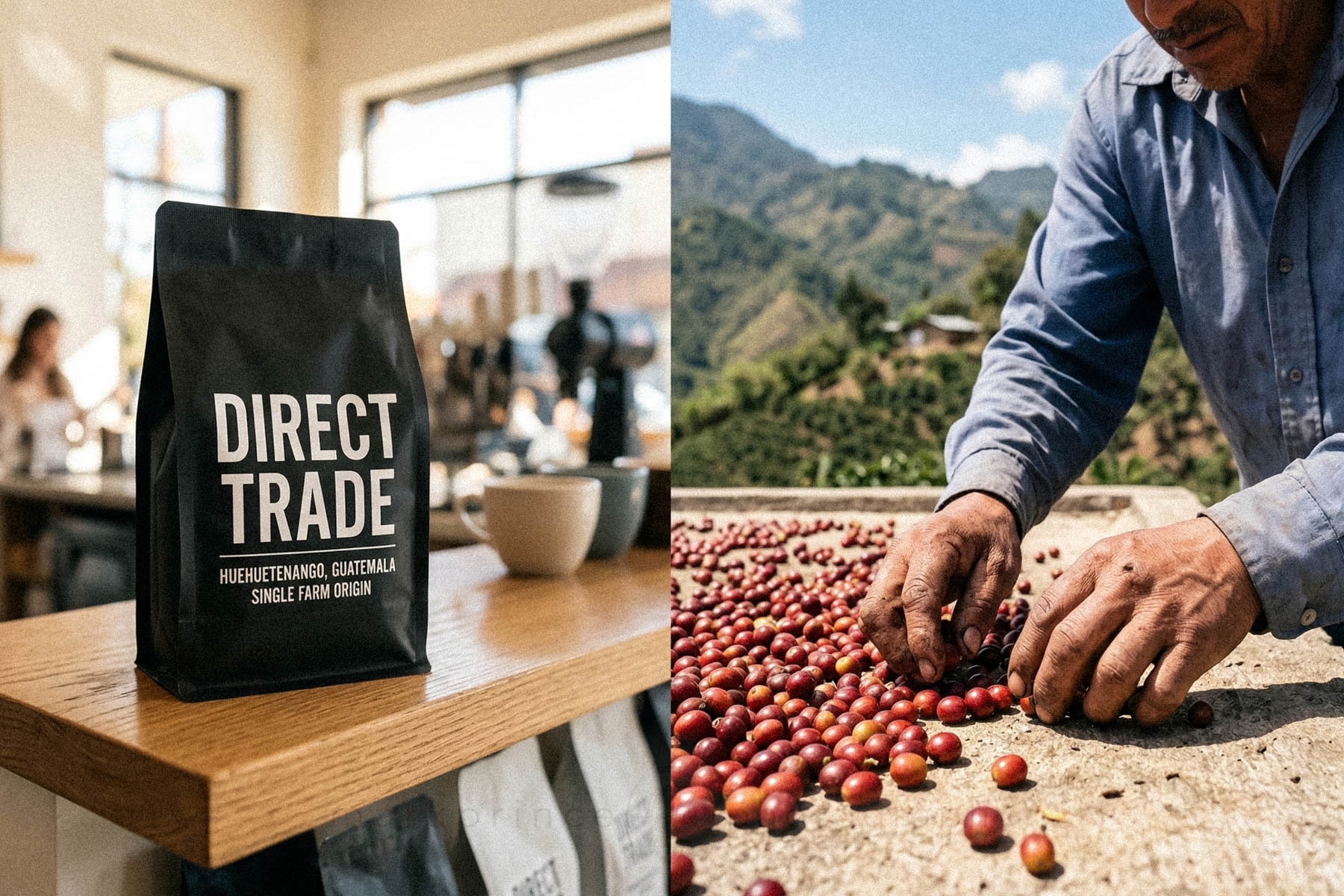
The bag on the shelf seems to be reliable. It says direct commerce in clear sans-serif kind, slightly below the tasting notes and simply above the identify of a farm in Huehuetenango. There’s {a photograph} of a person in a area. He’s smiling. The implication is evident: shopping for this espresso does proper by him.
Possibly it does. Possibly it doesn’t. The trustworthy reply is that the label alone received’t let you know.
The three phrases you’ll encounter most frequently on specialty espresso packaging are direct commerce, honest commerce, and commodity. They describe genuinely totally different relationships between purchaser and producer. Understanding what each truly requires, and the place each falls quick, is value your time. Not since you ought to really feel responsible about your morning cup, however as a result of this yr greater than most, the economics behind these labels have actual penalties for actual individuals.
The place “Direct Commerce” Really Got here From
Earlier than we get into what these labels imply at the moment, it helps to know the place essentially the most contested one got here from.
Within the late Nineteen Nineties and early 2000s, a small group of inexperienced espresso patrons had been touring to origin and discovering themselves annoyed. The espresso they had been shopping for handed via so many arms that even importers usually couldn’t inform them which farm it got here from. High quality was inconsistent and largely unverifiable. The pricing system rewarded quantity, not excellence. And the farmers rising the very best espresso had no method to be acknowledged or compensated for it.
Geoff Watts, then the inexperienced espresso purchaser at Intelligentsia Espresso in Chicago, is extensively credited with coining the time period “direct commerce” to explain a distinct strategy. He and Peter Giuliano of Counter Tradition Espresso in Durham, together with Stumptown‘s Duane Sorenson in Portland, had been touring to farms, constructing private relationships with particular producers, and paying costs tied on to high quality fairly than to commodity market fluctuations. They had been writing the mannequin from scratch, sharing concepts throughout roasters, and collectively altering what it meant to supply espresso responsibly.
Intelligentsia started utilizing “Direct Commerce” as an unregistered trademark round 2002. Stumptown put the phrases on its baggage and helped deliver the idea to a wider public. Counter Tradition constructed its personal sourcing philosophy across the identical ideas. For a second, it felt like a real motion.
All three of these unique roasters at the moment are owned by giant companies. Stumptown and Intelligentsia are each owned by Peet’s Espresso, which is itself owned by Keurig Dr Pepper. Counter Tradition stays impartial, although the panorama round it has modified enormously. The beliefs Watts and Giuliano articulated are nonetheless significant. Whether or not they survived the consolidation is a query value asking each time you see these two phrases on a bag.
Commodity Espresso: The Baseline
Most espresso on the earth, from the grocery retailer cans to the workplace drip to the quick meals cup, is commodity espresso. It trades on the C-market, the Intercontinental Alternate’s benchmark for arabica espresso, and its worth swings continually based mostly on climate forecasts, foreign money fluctuations, and speculative buying and selling by individuals who won’t ever contact a espresso cherry.
For a lot of the interval between 2017 and 2020, the C-market sat under $1.00 per pound. The price of producing a pound of washed arabica in lots of Latin American international locations runs between $1.20 and $1.60 per pound as soon as labor, fertilizer, water, and processing are accounted for. At these costs, farmers absorbed losses on each harvest.
2025 regarded totally different on paper. The C-market broke $4.00 per pound for the primary time for the reason that Nineteen Seventies, pushed by the extreme 2024 drought in Brazil, ongoing provide pressures in Vietnam, and vital volatility following the Trump administration’s import tariffs on espresso from most main producing international locations. These tariffs, which reached 50% on Brazilian espresso and 20% on Vietnamese imports, despatched U.S. retail costs up roughly 21% yr over yr. A bag of commodity floor roast that value $7 in 2023 crossed $9 by late 2025. As of early 2026, the C-market has pulled again to round $2.94 per pound as Brazil’s 2026 harvest is forecast to get better, however retail costs haven’t adopted it down.
Right here is the half that hardly ever makes the headlines: excessive C-market costs don’t robotically translate into higher lives for farmers. The C-market is a monetary instrument. The cash that strikes when costs spike usually strikes between merchants, hedge funds, and futures speculators. Whether or not any of it reaches the smallholder whose harvest set off the forecast that moved the market is a separate query fully, and ceaselessly the reply is: not a lot, and never rapidly.
Commodity pricing just isn’t a relationship. It’s publicity to a market that has no mechanism for caring whether or not the farmer survives.
Truthful Commerce: A Flooring, Not a Answer
Truthful Commerce certification, administered primarily by Fairtrade Worldwide and Truthful Commerce USA, was designed to deal with precisely this drawback. It units a worth flooring, at present $1.80 per pound for washed arabica, under which licensed patrons can not pay no matter what the C-market is doing. It additionally requires a social premium, an extra $0.20 per pound paid on to the farmer cooperative for group funding: colleges, well being clinics, infrastructure.
That is genuinely significant. When the C-market collapses, Truthful Commerce certification protects farmers from the worst of it. The social premium has funded actual issues in actual communities. These usually are not nothing.
However Truthful Commerce has structural limits value understanding. Certification applies to cooperatives, not particular person farmers, which implies smallholders who usually are not cooperative members are excluded fully. That may be a good portion of the world’s espresso farmers. The certification course of carries charges that smaller cooperatives generally battle to afford. And when the C-market trades above the Truthful Commerce flooring, because it did all through a lot of 2024 and 2025, the ground turns into irrelevant and Truthful Commerce affords no worth benefit in any respect.
There’s additionally the query of adequacy. A flooring of $1.80 per pound was set for a distinct market and has not stored tempo with rising manufacturing prices, climate-related losses, or the tariff pressures now hitting the availability chain. Truthful Commerce is a security web with holes in it. It was by no means designed to be a complete answer, and it shouldn’t be marketed as one.
Direct Commerce: A Promise With out a Regulator
Right here is the place language and actuality diverge most sharply, and the place the legacy of Watts, Giuliano, and Sorenson will get sophisticated.
“Direct commerce” has no governing physique, no certification commonplace, no third-party verification, and no agreed definition. It stays, because it was in 2002, an unregistered time period. Any roaster can print it on any bag.
At its greatest, direct commerce describes one thing genuinely useful: a roaster or importer who travels to origin, builds an actual relationship with a particular farm or cooperative, negotiates a worth instantly, pays considerably above Truthful Commerce minimums, and returns yr after yr. Intelligentsia’s revealed requirements, nonetheless accessible on their web site, decide to paying at minimal 25% above Truthful Commerce costs and to visiting direct commerce companions at origin at the very least as soon as yearly. I’ve seen this mannequin work. I’ve sat at tables the place these negotiations occurred and watched farmers obtain costs that modified what was attainable for his or her households and their land.
At its worst, direct commerce means a roaster purchased espresso from a dealer who purchased it from an exporter who sourced it from a washing station that aggregated cherries from dozens of farms, and someplace in that chain somebody visited origin as soon as and took {a photograph}. The farmer within the image could have acquired commodity costs. The bag nonetheless says direct commerce.
The hole between these two issues is big, and nothing at present stops an organization from occupying any level on that spectrum whereas utilizing equivalent language. Trish Rothgeb, who coined the time period “third wave” and has spent a long time observing the business, put it plainly: with out foundational paperwork and policing mechanisms, direct commerce most of the time is a advertising and marketing technique wrapped in a cloak of advantage.
What to Really Look For
This isn’t an argument for cynicism. It’s an argument for specificity.
When a bag says direct commerce, search for particulars. Does it identify a particular farm or cooperative fairly than only a area? Does the roaster publish the worth they paid, or at minimal verify it exceeds Truthful Commerce minimums by a significant margin? Have they got a documented ongoing relationship with that producer throughout a number of harvests, not a single buy? Some roasters reply these questions overtly on their web sites. These are those whose claims are value taking severely.
Fairtrade Worldwide certification, for all its limitations, is at the very least verifiable. Search for Fairtrade Worldwide certification fairly than Truthful Commerce USA if you’d like the stricter commonplace. The 2 organizations break up in 2011 and have totally different necessities, a distinction the packaging hardly ever makes apparent.
And take note of worth. In a market the place retail baggage have crossed $9 per pound for commodity-grade floor espresso, genuinely sourced specialty espresso will value extra. If the worth appears too low for the story on the label, belief the worth. Espresso that was grown with care, bought at a worth that permit the farmer reinvest in subsequent season’s crop, and imported via a relationship fairly than a dealer doesn’t come low-cost. It by no means did.
The Bigger Level
The individuals who created direct commerce had critical ethical intentions. Geoff Watts and Peter Giuliano weren’t constructing a advertising and marketing class. They had been attempting to assemble a commerce mannequin that labored higher for everybody, producers included. The roasters who carry that work ahead actually are doing one thing that issues.
The issue just isn’t the intention behind the time period. It’s the hole between what it guarantees and what it ensures, and the convenience with which that hole will be exploited.
That hole is the place advertising and marketing lives. And in a yr when American shoppers are paying file costs for espresso whereas farmers in lots of origins are nonetheless preventing for sustainable returns, understanding that hole just isn’t a minor shopper concern. It’s the entire story.
Marisol Rivera is a Santa Fe-based author and journalist who’s now masking the worldwide espresso commerce for CoffeeGeek. With a background in anthropology and over a decade of area expertise throughout Latin America, East Africa, and Southeast Asia, she brings a ground-level perspective to tales about origin, provide chains, labor, and the environmental realities of espresso manufacturing.
Earlier than turning to journalism, Rivera labored as a roaster and later as a inexperienced espresso purchaser for a direct commerce importer, giving her firsthand expertise on each side of the buyer-producer relationship. She has visited farms, moist mills, and processing amenities throughout a number of continents, and writes for the total spectrum of CoffeeGeek readers, from curious learners to seasoned specialty espresso lovers.


1 Pack Glass Cup, 16oz Drinking Glass with Bamboo Lid and Straw, Beer Glass Tumbler for Mojito Soda Smoothies Whiskey Iced Coffee Cocktail Tea Juice

10 oz Tumbler with Handle and 2 Straw 2 Lid, Insulated Water Bottle Stainless Steel Vacuum Cup Reusable Travel Mug, Mint






Hello my friend! I wish to say that this post is amazing, great written and include almost all significant infos. I’d like to peer extra posts like this.